
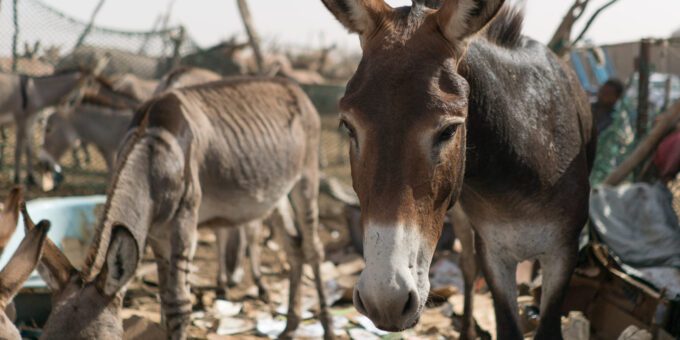
The lifelines we rarely see
From the deserts of Mauritania to the smallholder plots of Kenya, donkeys haul water, food and fuel that sustain whole communities. They are, quite literally, the engines of rural resilience – yet their own welfare is often neglected. On International Working Animal Day 2025, SPANA celebrated these ‘unsung heroes’ and the owners who share their scarce water with them.
But behind the uplifting stories lies a crisis driven by demand for ejiao, a gelatin made from donkey skins and used in traditional medicine in China. While historically prized in the luxury market, it is growing in popularity among young urban middle classes.
Why a 'minor' demand became a major disaster
China’s population tops 1.4 billion. Even if only a few per cent purchase ejiao, the absolute volumes are enormous. The result has been catastrophic for donkey welfare and communities who depend on them:
- Between 2012 and 2020 an estimated 4 million donkeys were slaughtered for their skins. That estimate has now risen to 5.9 million donkeys being killed every year, as of 2024.
- There has been 40 – 60 per cent herd declines in parts of the Sahel, forcing women and children to walk ever-longer distances for water and market goods and disrupting a crucial means of transport in pastoralist systems.
- Skyrocketing prices have pressured vulnerable households to sell their only donkey, often against their own long-term interests, while making it harder for the poorest to access these essential animals and thus eroding rural livelihoods.
- Smuggling networks move animals across thousands of informal crossings, undermining animal health surveillance and spreading diseases such as African Horse Sickness across a vulnerable continent where animal health and disease control systems are often weak.
Africa draws a line in the sand
In February 2024, the African Union adopted an historic continent-wide moratorium on commercial donkey slaughter and skin exports. Member States then began crafting a Pan-African Strategy for the Preservation of Donkey Species (2026–-2035), complete with enforceable policy standards, including custodial sentences for traffickers. The strategy is not only a conservation blueprint, but a moral and economic shield for Africa’s most vulnerable.
This unified stance is already inspiring progress, such as dedicated harmonised systems codes, which make it possible to detect donkey skins in transportation. Community breeding schemes are also being piloted to rebuild depleted herds.
What SPANA is doing – and how you can help
- We use our global platform to raise awareness of this cruel trade and the urgent need to implement the ban.
- We work alongside local partners, such as the African Network for Animal Welfare, who support law enforcement efforts to enforce the ban in Kenya.
- We will continue advocating for the Pan-African Strategy for the Preservation of Donkey Species to be fully domesticated in every Member State.
Your voice matters. Share this article and consider donating to SPANA so that these quiet labourers receive the protection they deserve. Because when donkeys thrive, Africa’s communities thrive.

By Mwenda Mbaka, SPANA Trustee