
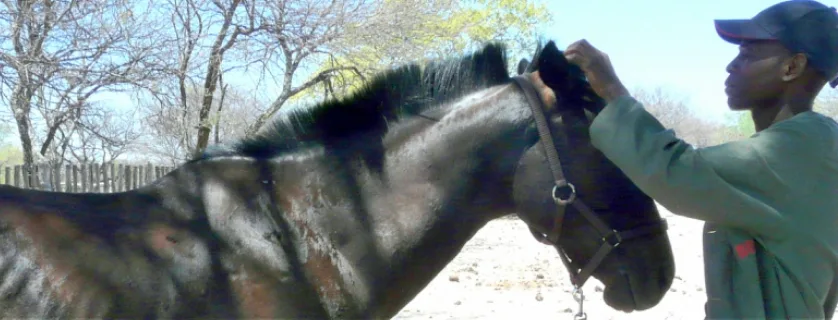
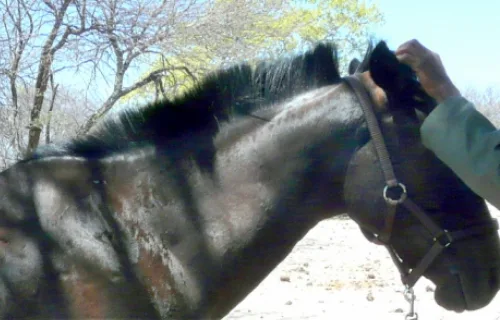
For horse, donkey, and mule owners, finding the right fit for a saddle or harness can be challenging. Fitting equipment comfortably around an animal’s withers, the highest point above the shoulder blades, is especially important. For animals with naturally high withers, the slope to their back is steep, improving their stride and speed, but making it tough to find a saddle that doesn’t pinch the highest point of their back.
In Western countries, high withers are most commonly seen in thoroughbreds, saddlebreds, and warmblood horses, and made-to-measure saddles can be ordered to conform to each animal’s specific conformation. However, throughout the world, many working animal owners cannot afford to provide the specialised saddles and soft saddle pads needed to make their high withered animals more comfortable.
When working horses are fitted with rough harnesses and saddles made of rope, plastic, untreated wood or even metal, the constant rubbing and pressing against the withers can lead to very serious medical problems, including a condition called fistulous withers.
Symptoms, Causes and Treatment of Fistulous Withers
Fistulous withers, also known as ‘saddle sore”, is a painful condition that is caused when open wounds at the withers become infected. It’s often the consequence of something as simple as the constant rubbing of a saddle or harness, which eventually leads to the introduction of a bacterium called Brucella around the sensitive tissue of the animal’s shoulders.
If left untreated, the condition can progress into a chronic infection, causing discharge, pain, fever, and lameness. Horses, mules, and donkeys suffering from fistulous withers are often brought to SPANA centres lethargic and in severe discomfort, frequently with open wounds and draining tracts along their backs.
Vets can reduce the swelling and discomfort with non-steroidals, systemic antibiotics, and, at times, perform surgery to resect the infected tissue, but if the animal continues to be worked with uncomfortable and unsuitable equipment, the problem will persist or return.
Additionally, the infection can spread to and from cattle, posing a threat to other livestock, sometimes causing abortions, and jeopardising the livelihoods of people who rely on their herds for survival.
Farmer Laghribi Atef relies on his small six-year-old horse Kais to help him plough the land of his small plot near El Faouar, Tunisia. Laghribi used a homemade harness of rope and metal to attach Kais to the plough to till the soil and the small cart he uses to bring goods to market.
Laghribi had become concerned when he noticed that Kais’s shoulder area had begun to swell, becoming hot and painful to the touch. His usually spirited animal was lethargic and clearly in a lot of pain. SPANA vets immediately recognised the cause of the problem, and they showed Laghribi that the angry, swollen wounds around Kais’ shoulder had become infected.
After cleaning the wound and administering antibiotics and pain relief, our vets gave Laghribi some simple doughnut-shaped padding to ease the pressure on the animal’s shoulders, explaining the importance of giving the hard-working horse regular breaks. This was not a long-term solution, as the doughnut padding will wear out, highlighting the importance of education around proper harnessing.
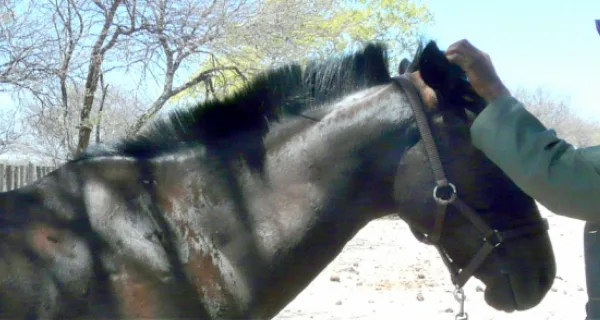
The solution to this serious problem is a simple one – comfortable and well-fitting equipment can stop fistulous withers before it starts. SPANA vets work with communities around the world to teach people how to best fit saddles, harnesses, and saddle pads to guard against infections like fistulous withers and make the lives of their working animals more comfortable.
Read more about how you can support the work of SPANA vets in educating owners about the importance of using the right equipment. Simple equipment can make all the difference for the comfort and wellbeing of these hardworking animals and SPANA is working to make sure that conditions like fistulous withers are not only treated, but also prevented. Learn how you can be part of the solution for working animals.