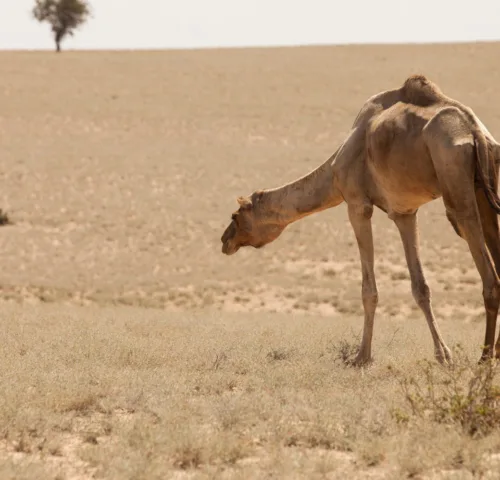
When drought, conflict or natural disaster threaten, those with fewest reserves on which to fall back – the poorest and most vulnerable in society – tend to suffer most.
In low-income countries globally, the most marginalised are also those most likely to depend on animals for their survival. As much of Africa once more faces drought and extremes of climate, it is pastoralist communities who are again most threatened.
In many of the areas where SPANA works, it has long been recognised that the mass death of animals is often a precursor to humanitarian tragedy. By protecting working animals and livestock we ensure stronger, more secure communities.
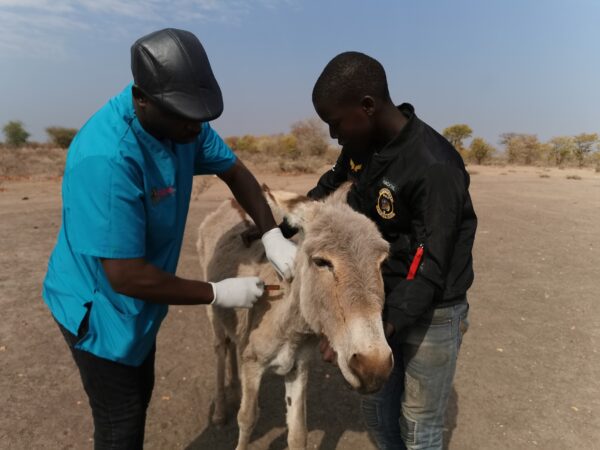
Recent emergencies
Zimbabwe drought, 2024
In 2024, Zimbabwe was ravaged by a severe El Niño-induced drought. This global weather pattern causes increased temperatures, prolonged dry spells and reduced rainfall. The country’s government declared a national state of disaster and communities told our Zimbabwe team that it was ‘the worst drought in the last six decades’.
Two areas of the country hit particularly hard were Chivi and Shashe. These southern rural areas are dependent on agriculture and have a large population of working donkeys.
In response, we launched two emergency projects, which helped support 2,200 working donkeys in Chivi and Shashe. We drilled and installed four solar-powered boreholes to provide access to water for both animals and people. The work was challenging as it involved drilling beyond 100 metres; therefore, local expertise was crucial in identifying suitable waterpoint sites. Troughs were installed at each borehole to provide drinking water for animals.
In addition, we supplied 128,000kg of emergency feed to support 2,200 donkeys from September to December 2024.
Uganda landslide, 2024
In August 2024, heavy rainfall in Uganda’s capital, Kampala, caused a devastating landslide at a rubbish dump. The disaster destroyed the homes of 200 people, killed 30 and forced survivors to flee. The landfill is the only rubbish disposal site in the city, which is home to around 4 million people, and covers 37 acres of land – an area the size of more than 22 football pitches. The disaster most impacted those earning a living as rubbish collectors, and their working animals who help them. Many people had no choice but to abandon their animals as they sought safety.
SPANA funded an emergency project so that local partner organisation, Animal Welfare and Protection Organisation (AWPO) could step in to support those animals left vulnerable to food shortages, dehydration and injury. The teams were able to provide emergency feed, vital veterinary care and shelter to 600 displaced animals over four months while working animals and their communities relocated to a safer environment.
Morocco earthquake, September 2023 to present
On 8 September 2023, Morocco was struck by a 6.8-magnitude earthquake. The epicentre was in the High Atlas Mountains – a remote area south of Marrakech where working animals are relied on to transport essential goods to isolated communities. According to the Red Cross, more than six million people were affected, and an estimated 3,000 people lost their lives.
Morocco is home to SPANA’s largest programme, and our veterinary activities there were established by our co-founder, Kate Hosali, in 1925.
Within days of the earthquake, we launched the most ambitious emergency response project in our charity’s history, backed by an emergency fundraising appeal. Our veterinary teams headed to the epicentre to provide lifesaving treatment and care to thousands of animals who had been injured and displaced by the earthquake. This included working alongside rescue teams to free working animals trapped under collapsed buildings. Working animals who supported the rescue effort by transporting much-needed supplies were also helped by our vets.
We are continuing to distribute emergency feed and provide veterinary care to affected working animals.
India water buffalo vaccinations, 2022
In 2022, a severe outbreak of haemorrhagic septicaemia in Manipur, eastern India, led to the deaths of nearly 1,000 water buffalo in just two months. SPANA provided funding so that local partner, the Institute of Social Research and Development (ISRD), could launch an emergency vaccination programme to protect water buffalo against this deadly and contagious disease. The initiative not only saved lives, but also strengthened awareness of the disease and prevention in the community via dedicated training.
The Veterinary and Animal Husbandry Services of the government of Manipur recognised the vaccination programme’s success and long-term benefits for water buffalo and the people of Manipur who rely on them, and has now agreed to fund the vaccinations in future – protecting around 19,000 water buffalo in the region.
Covid-19 emergency projects, 2020–2023
The impact of the Covid-19 pandemic has had devastating consequences for working animals in vulnerable communities across the world. Lockdowns and restrictions on movement have left many people with no work or income, and owners have been struggling to feed or care for their animals. Malnutrition and dehydration have threatened the survival of countless animals in many low-income communities.
In response to this crisis, SPANA undertook a series of emergency projects in some of the hardest hit locations, providing lifesaving feed, water, shelter and emergency veterinary care to animals in desperate need.
Our projects included emergency feeding programmes in Ethiopia, Mali, Mauritania, Morocco, Tanzania and Tunisia, which distributed more than 267,000kg of feed in 2020.
Kenya drought, 2018
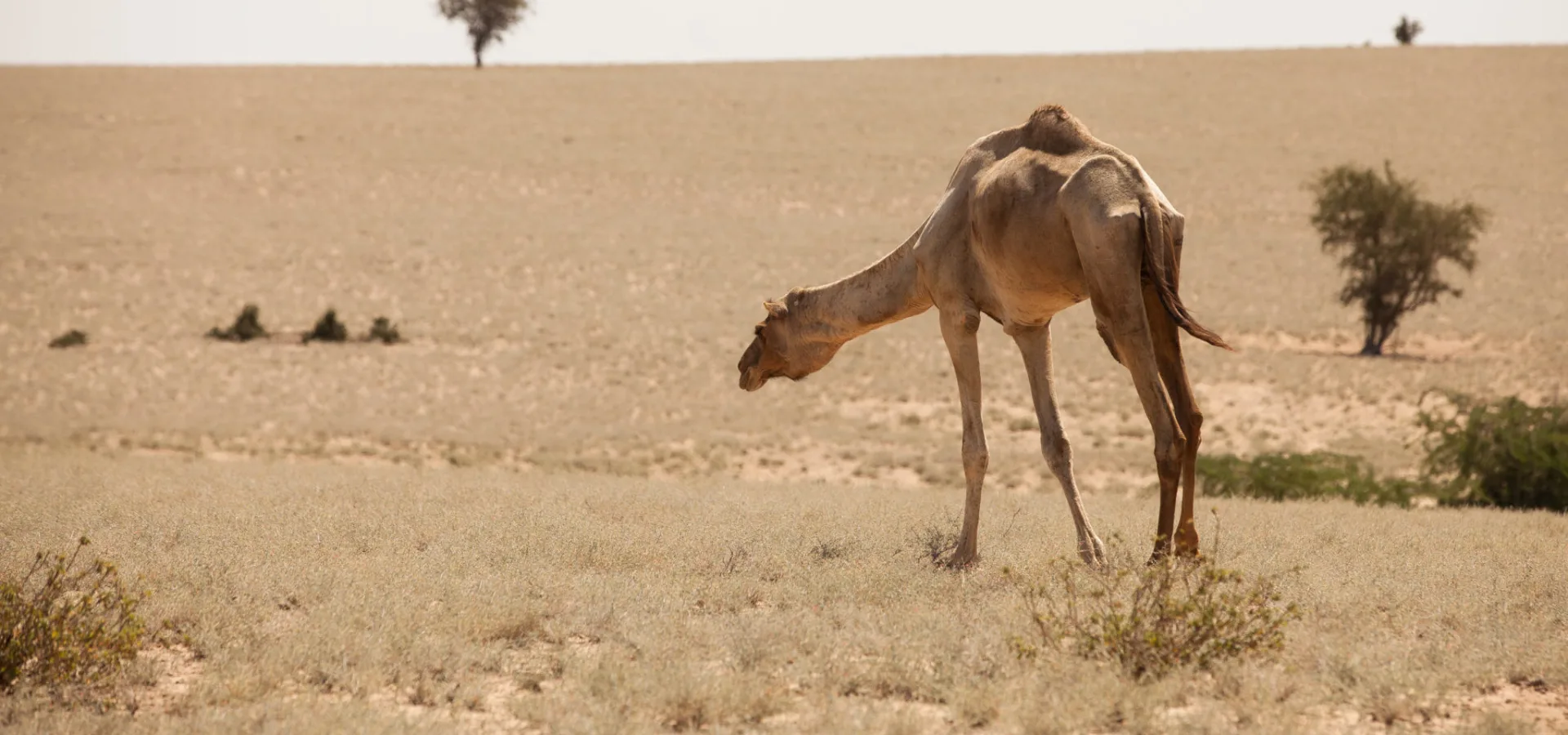
After a series of failed rains over consecutive years, millions of animals in Turkana, north-west Kenya, were close to starvation.
The nomadic tribespeople of the region are pastoralists, relying totally on large herds of cattle, donkeys and camels to survive against the odds in this expansive desert environment.
SPANA has been working in Turkana for over a decade, supporting local organisations and improving water access for those animals at greatest risk.
In 2018, SPANA funded the construction of a 110-metre-deep solar-powered borehole, to get help to animals now and for many years to come. The borehole became operational in September, with two animal troughs and a water kiosk supplying 4,200 people and 15,076 donkeys, camels and livestock from four nearby villages.
With clean water now flowing freely, animals and people no longer need to travel long distances to collect dirty water. The community reports that animal health has improved, with fewer miles covered in search of water, better control of disease and a reduction in the number of animal thefts.
Ethiopia Emergency, 2016
Following the most severe drought in Ethiopia in over 50 years, last year SPANA undertook an emergency feeding programme in Afar, one of the worst hit regions. Local people in Afar are mostly pastoralists who rely entirely on livestock for their livestock and for produce such as milk.
In total, SPANA fed 7837 livestock and working animals belonging to the poorest families over a four month period, distributing more than 150 tonnes of feed.
SPANA also put in place longer term measures to assist people and their animals in the region long after the end of the drought. The charity planted 10 hectares of drought-resistant grasses to provide an ongoing, local food supply for livestock.
During the emergency, SPANA highlighted the lack of attention being given by the international community to tackling livestock deaths. Many of the most vulnerable people in Ethiopia depend on livestock for both economic and food security. SPANA warned that the failure to learn from the mistakes of the past and to take action to protect existing herds could lead to a complete collapse in livestock numbers, preempting a devastating humanitarian crisis across the country.
Egypt Emergency Feeding, 2014
In 2014, the collapse in Egyptian tourism following years of political unrest had a devastating impact on animals working in the tourism industry, close to the Giza Pyramids. During the year SPANA worked with Egyptian charity ESAF, providing emergency feed to hundreds of malnourished carriage horses.
Crisis in Mbera, 2012
In Mauritania, SPANA worked to save the lives of animals caught up in civil war and drought as tens of thousands of pastoralists crossed the Mali border to a large refugee camp in Mbera. SPANA was the only organisation providing support to the animals in the camps, vital for the long term survival of people, communities and animals.
Drought in Kenya, 2011
SPANA funded feeding programmes in the far north east of Kenya, just a few miles from both the Somali and Ethiopian borders. It was the very epicentre of the crisis, with poor and dispossessed refugees arriving every day. Many were nomadic pastoralists: people who depend totally on livestock and working animals for transport, trade, milk – everything. When they lost their animals, they had no choice but to try and reach a refugee camp. With their animals gone, these people had no way to sustain themselves and became trapped in the camps, reliant on food aid. SPANA worked to prevent that. By providing fodder, veterinary help and vaccinations to working animals and livestock in terrible need. We helped families retain their independent livelihood and secured the long-term future for animals across the region.
To find out more about applying for funding for an emergency outreach project, please click here.